Hello! I am Tobin Wainer. I graduated from the University of Washignton in Auguest of 2026 with a PhD. Astronomy. I have a broad range of research interestests, primarily focuses on star formation. Please check out the research tab to see more.
Research
For a complete list of my Publications, click here .
Star clusters are fundamental laboratories for astrophysics. Most stars form in clustered environments. My research uses these stellar clusters as laboratories to uncover the physics of star formation, combining resolved-star observations, high-resolution simulations, and time-domain studies to test the underlying physics of how stars form.
Star Clusters in M33
Our main goal was to construct a catalog of Star Clusters in the Triangulum Galaxy(M33) using data from the Hubble Space Telescope. We used the Citizen Science platform hosted by zooniverse.org to conduct a visual search for star clusters. Because star clusters are a key tool to studying star formation at different epochs, this catalog will be the basis of gaining usefull information about one of our nearest galactic neighbors.
Here is an example of a Hubble Space Telescope image that a volunteer would view and try to identify clusters, and on the right is where volunteers said clusters were located.
This star cluster catalog was the basis for my next project, measuring and analysing the star cluster mass function of M33. The star cluster mass function provides valuable insights into how large star cluster can be in a galaxy, which we found to be consistent with the local star forming rates. In addition, we analyzed how impactful individual star cluster mass uncertainties are in measuring the cluster mass function.
On the left is the distribution of star cluster masses in M33, with the best-fit mass function parameters overploted, and the right plot shows a clear coorelation between the truncation mass of a galaxy's cluster mass function and that galaxy's star formation.
Simulating Star Formation
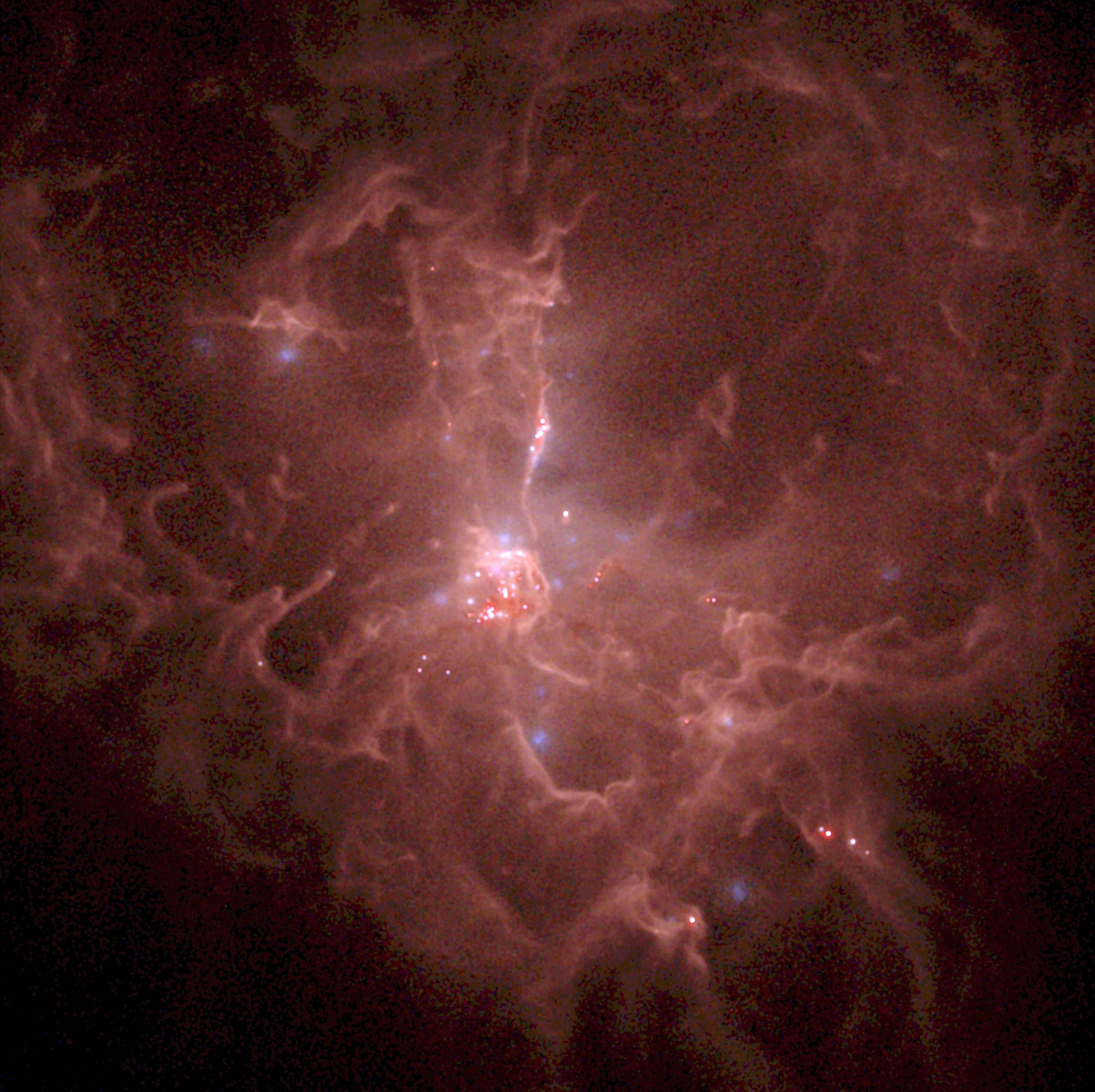
Observationally, distinguishing between long-lived, gravitationally bound clusters and unbound stellar associations is notoriously difficult. To address these questions, using the STARFORGE simulations (Grudic et al. 2021), I have analyzed the embedded stage of formation, showing that embedded timescales are fundamentally tied to timing of massive star formation, with gas clearance scaling with cloud mass. I have also made mock observations of the simulations for at wavelengths never before looked at.
Three-color composite image of the STARFORGE simulation- R: 80-120 \micron, G: 6-13 \micron B: 20-30 \micron- were chosen to best represent the SED, where red is the peak of the SED showing cold dust, green shows the primary PAH features, and blue shows the features arising from hot dust.
Tracing Star Formation
Over Millions of Years
in M31
Using HST data from the PHAST survery (Chen et al. 2025), I measured the resent star formation history of M31 from resolved stars. By combining the PHAST and PHAT surveys, we have access to photometry from 0.2 billion stars across two thirds of M31's disk, offering the first wholistic picture of the star formation in our nearest neighbor from homogeneous data. We found evidence of a large decline in M31's SFR over the last 500 Myr, which we interpret to be the late stages of a decline that has lasted several Gyr since a large burst around 2 to 4 Gyr ago (Williams et al, 2015; 2017). Additionally, because the star formation is occurring primarily in the ringed morphology of the galaxy, we are seeing a reduction in the rings themselves, offering clues to how long ringed structures can last. These results provide a stringent test of galaxy evolution models, which must simultaneously reproduce the diverse observational constraints on the formation and evolution of an L* galaxy.
This movie, created from an analysis of data from NASA’s Hubble Space Telescope, demonstrates how the rate of star formation in the Andromeda galaxy has declined over the past 500 million years. Brighter colors indicate where star formation was highest during a given time. Visualization: Tobin Wainer (UWashington); Image Processing: Joseph DePasquale (STScI); Video: NASA, ESA, STScI, Gregory Bacon (STScI)
I grew up in Moab, Utah, and fostered an avid love for the outdoors. Ouside of work, I love backpacking, skiing, mountaineering, and climbing. I am also an avid sports fan, following the Denver Broncos, Utah Jazz, and Colorado Rockies.
Contact
You can reach me by email at: tobinw [at] uw.edu
Also, here is a link to my Linkedin and github profiles.
Elements
Text
This is bold and this is strong. This is italic and this is emphasized.
This is superscript text and this is subscript text.
This is underlined and this is code: for (;;) { ... }. Finally, this is a link.
Heading Level 2
Heading Level 3
Heading Level 4
Heading Level 5
Heading Level 6
Blockquote
Fringilla nisl. Donec accumsan interdum nisi, quis tincidunt felis sagittis eget tempus euismod. Vestibulum ante ipsum primis in faucibus vestibulum. Blandit adipiscing eu felis iaculis volutpat ac adipiscing accumsan faucibus. Vestibulum ante ipsum primis in faucibus lorem ipsum dolor sit amet nullam adipiscing eu felis.
Preformatted
i = 0;

while (!deck.isInOrder()) {
    print 'Iteration ' + i;
    deck.shuffle();
    i++;
}

print 'It took ' + i + ' iterations to sort the deck.';